Verified Citations for AI Answers: When to Say I Don't Know
An AI answer cites a real fund document. Would you check that the page actually says what the answer claims?
IN 30 SECONDS
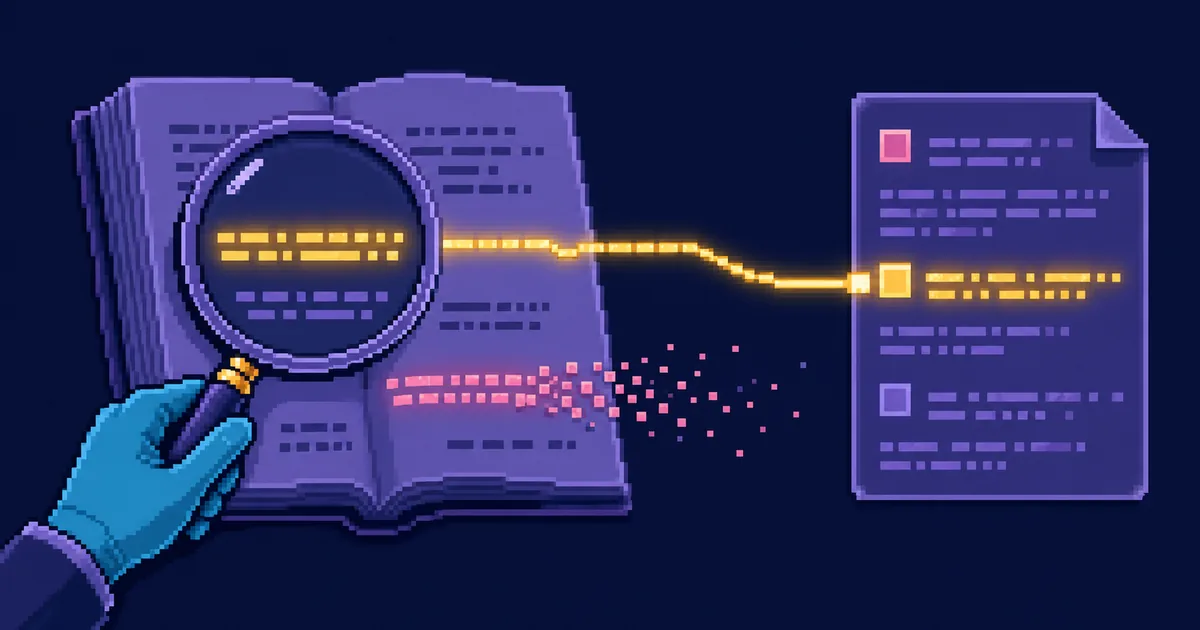
A verified citation is a link from an AI answer to the exact source passage, checked to see if that passage supports the claim. When a check fails, the system is built to say “I don’t know” and hand the question to a person.
KEY TAKEAWAYS · 3
- A RAG system that can’t say “I don’t know” is a liability. Near a fund’s books, the goal is zero confident wrong answers, not maximum coverage.
- A verified citation points to the exact source passage and has passed a meaning check and a number check. A pass is evidence of support, not proof.
- I built this inside a US real-estate private-equity fund with roughly $3B in assets under management: citation checks, abstention, evaluations and red-teaming (deliberate attacks to find failures).
On this page
The problem: a real source behind a wrong answer
IN SHORT Near a fund’s books, a confident wrong answer costs more than a slow one, so this system is built to abstain when checks fail.
I shipped a RAG system that checks every citation. It ran in a confidential US real-estate private-equity fund with roughly $3B in assets under management.
The failure it targets is quiet. The assistant cites a real fund document, but the page doesn’t back its answer. That is an illustrative case, not a client incident reported here.
A citation that is only attached
A verified citation
A citation nobody checks looks sourced, so people trust it.
I built the citation checks, the number checks and the abstention. Zero unsupported answers is the target in evaluation, not a firm promise about production.
Coming up next: So what makes a citation “verified”?
What a verified citation actually means
IN SHORT A verified citation points to the exact passage and records whether checks found that it supports the claim.
WORDS TO KNOW
- RAG
- Retrieval-augmented generation: the model first searches your documents, then writes its answer from what it found.
- Source span
- The exact passage of a source document that one sentence of the answer relies on.
- Citation
- A link from a sentence in the answer to its source span, so a person can open it and check.
- Abstention
- The system declining to answer because the evidence is thin. It says “I don’t know” instead of guessing.
In RAG Retrieval-augmented generation: the model first searches your documents, then writes its answer from what it found. See the glossary, the model first searches your documents, then writes from what it found. A Citation A link from a sentence in the answer to its source span, so a person can open it and check. See the glossary links one sentence of the answer to the exact passage behind it. That passage is its Source span The exact passage of a source document that one sentence of the answer relies on. See the glossary.

IN PLAIN WORDS
A link makes an answer checkable. To rely on it, you still ask two things: does the passage support this exact claim, and is the source current and authoritative?


ADAM says: My checker works like a strict teacher who opens the book at every footnote. Where it breaks: it’s a model, so it can miss things too.
A passed check is evidence of support, not proof. It is a model’s judgment, and it can be wrong. Its misses belong in the evaluation set, the test questions the system is scored on.
Coming up next: So where do these checks sit in the system?
Four steps: retrieve, cite, verify, then answer or abstain
IN SHORT Every question goes through the same four steps, and the last one forks.
STEP BY STEP
Step 1. Retrieve. The system pulls the passages that could answer from Postgres with pgvector, a database extension that finds the closest ones.
- Retrieve The system pulls the passages that could answer from Postgres with pgvector, a database extension that finds the closest ones.
- Cite as you draft Each sentence the model writes carries the exact passage it came from. A claim with no passage never leaves this step.
- Verify each citation One check asks whether the passage supports the sentence. Another confirms each figure matches the source to the digit.
- Decide: answer Every claim is supported: the answer goes out with its citations.
- Decide: abstain Any claim fails: the system doesn’t patch the answer. A person gets the question, what was found and where it stopped.
This ran as the shared answer layer under the fund’s 11-agent platform. Every agent that read a document inherited the same citation checks.

ITEM GET
No passed check, no answer
WATCH OUT
Abstention The system declining to answer because the evidence is thin. It says “I don’t know” instead of guessing. See the glossary sends the evidence failures the checks detect to review. It reduces risk, but it doesn’t guarantee that every unsupported answer is caught. And one failing claim stops the whole answer: sending only the good parts would need a written policy, with its own evaluation cases.
STAGE CLEAR
What you now know
- Why a real source can still sit behind a wrong answer.
- What a verified citation adds: a meaning check and a number check against the exact passage.
- Why the last step forks: an answer with its citations, or an abstention a person picks up.
Check yourself
Tap or click a question to see the answer.
Illustrative case: an answer cites a real lease, and every check passes. Is the answer now proven true?
No. A pass is evidence of support, not proof: the check is a model’s judgment and can be wrong, and the source may be out of date.

Former CTO of Integra. Named author (1 of 5) of ERC-3643, first author of ERC-6960, co-author of ERC-7410, and co-author of ERC-8203, which is still a draft. Building production AI and regulated Web3 systems.
Have a project to ship or a role to fill?
Discuss your project or roleFollow the engineering notes
Get new articles on production AI and smart contracts by email.