SEC Innovation Exemption: The Token Layer It Left Open
IN 30 SECONDS
The SEC innovation exemption is a five-year, conditional order that lets venues offer trading in tokenized US-listed shares, in permissioned pools (approved wallets only) on a public blockchain. It names two places the access check can live, the pool or the token, and requires neither. This post shows what each choice can and can’t stop, from public documents only.
KEY TAKEAWAYS
- The SEC innovation exemption (Release No. 34-106402) runs from 17 September 2026 to 17 September 2031. Under conditions, it lets tokenized US-listed shares (tokenized NMS stock) trade in AMM pools that only approved wallets can use, on a public, permissionless chain. AMM means automated market maker: smart contracts set the price. NMS means National Market System, the US framework for listed stocks.
- The order gives two examples of where the access check can live: in the pool, or in the token itself. It asks the venue to describe its procedure. It doesn’t pick the mechanism.
- OKXICE’s public notice puts the check in the pool: a Uniswap v4 hook that only lets wallets holding a soulbound token trade. ERC-3643 puts it in the token, on ordinary holder transfers.
- A pool gate controls who trades in the pool. It doesn’t check a direct wallet-to-wallet transfer; a token-level check can. Ask which one a venue relies on.
- A token contract alone can’t establish some conditions: same rights as the underlying share, custody backing in a third-party model, a timely halt signal. Those rest on legal documents, attestations and operations.
On this page
The problem: an open chain, a closed pool, and no set place for the gate
IN SHORT Where the gate sits decides what a venue can still enforce once a token leaves the pool.
Under conditions, the SEC (the US Securities and Exchange Commission) now lets tokenized NMS stock (shares listed in the US; NMS stands for National Market System) trade on a public blockchain. The trades happen in pools that only approved wallets can use.
The chain
- Anyone can read it.
- Anyone can write to it, without asking.
Trading in the pool
- Only wallets the venue approved can trade.
- The venue sets and publishes the access rules.
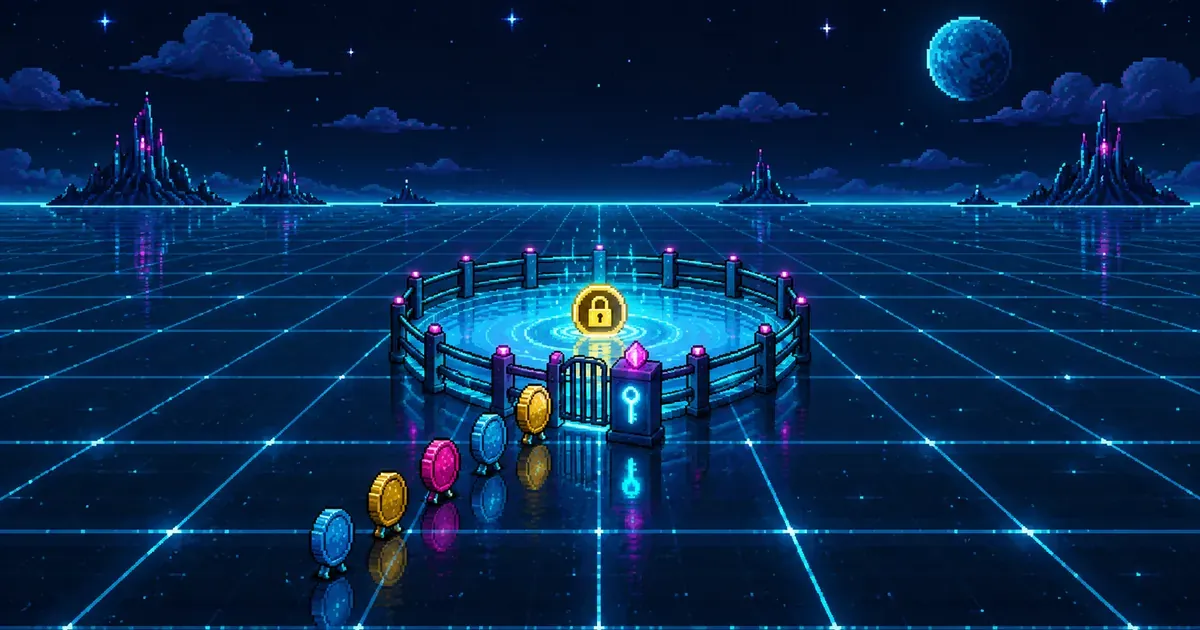
The order describes two places the check can live, in the pool or in the token, and mandates neither.
That’s where someone who helped write a token standard can add something. So I read the order from that angle.
Words to know before reading the order
IN SHORT An open chain with a gated pool works like a members-only room inside a public building.
WORDS TO KNOW
- Tokenized NMS stock
- Roughly, a share listed on a US stock exchange (NMS: National Market System), turned into a blockchain token by its issuer or by an unaffiliated third party.
- Tokenized Securities Venue (TSV)
- A trading venue that runs pools for tokenized NMS stock and sets the standards for who may trade there.
- AMM liquidity pool
- AMM means automated market maker: smart contracts that hold two assets, here a stablecoin and a stock token, and set the price by a formula.
- Permissionless blockchain
- A public blockchain that, generally, anyone can read or write to without asking for authorization.
- Soulbound token (SBT)
- A token that can’t be transferred and stays in one wallet. A venue can issue one as a badge: this wallet passed our checks.
- Pool layer
- Putting the access check in the trading pool: only approved wallets can trade there. Transfers outside the pool never reach that check.
- Token layer
- Putting the access check in the token contract itself, so an ordinary transfer fails unless the receiver is eligible, wherever it happens.
What the SEC granted on 17 September
IN SHORT Release No. 34-106402 gives two exemptions, each for five years and each under conditions.
The first is for a Tokenized Securities Venue (TSV) A trading venue that runs pools for tokenized NMS stock and sets the standards for who may trade there. See the glossary (TSV) that runs AMM liquidity pool AMM means automated market maker: smart contracts that hold two assets, here a stablecoin and a stock token, and set the price by a formula. See the glossary for Tokenized NMS stock Roughly, a share listed on a US stock exchange (NMS: National Market System), turned into a blockchain token by its issuer or by an unaffiliated third party. See the glossary. It exempts the venue from the legal definition of an “exchange”.
The second exempts some liquidity providers in those pools from the definition of a “dealer”. The table lists the main conditions.
17 Sep 2026: order issued
Exemptions start the same day. The order asks for public comment (File No. 4-927).
22 Sep 2026: Federal Register
Cited as 91 Fed. Reg. 60168 in the OKXICE notice.
4 Oct 2026: OKXICE public notice
It lists 63 tokenized-stock symbols (my count). It already reports one issuer objection, from Cerebras Systems.
17 Sep 2031: exemptions end
Unless the SEC changes their length or terms.
Permissioned trading on a permissionless chain
IN SHORT The chain must stay open to everyone, while trading on the venue is restricted.
A TSV’s smart contracts “must be auditable, public, and deployed on a public, permissionless distributed ledger”. That’s a Permissionless blockchain A public blockchain that, generally, anyone can read or write to without asking for authorization. See the glossary, which the order says “generally means that anyone can read or write to the distributed ledger without authorization.”
Footnote 55 then adds: “A permissioned AMM Liquidity Pool can be deployed on ‘permissionless’ blockchain.”
The order then gives two ways to build the gate. A pool “may be encoded with criteria or a list of persons” so only allow-listed wallets trade.
“Alternatively, a Tokenized NMS Stock could be encoded with criteria to only allow transfers” to the wallets of people who meet the venue’s rules. One check sits in the venue, the other in the asset.
So a public chain was a design question before it was a regulatory one. I covered that tradeoff in when RWA (real-world asset) tokenization needs its own chain.
Describe the access procedure; no implementation is mandated
IN SHORT The order asks the venue to describe how it grants access, not to use a given mechanism.
Item (f) of the required notice is the closest the order gets to an access spec. It asks for the criteria and “the procedures for approving access (e.g., white-listing or permissioning)”.
It also asks when the venue refuses or limits access. Sanctions from OFAC (the US Treasury’s Office of Foreign Assets Control) and AML/CFT rules (anti-money laundering and countering the financing of terrorism) are among the reasons.
Standards used to grant a person access.
How participants or wallet addresses get approved.
How the venue verifies who a person is.
When access is denied or limited.
If another firm runs the checks for the venue, the order says the TSV is still responsible. The procedure stays the venue’s, whatever code or vendor runs it.
Pool layer vs token layer: OKXICE next to ERC-3643
IN SHORT OKXICE checks a badge in the pool on every trade; ERC-3643 checks the receiver inside the token on every ordinary transfer.
OKXICE TSV published its public notice on 4 October. Its operator, OKXICE LLC, is a joint venture between Intercontinental Exchange Holdings and OKC USA Holding. I use it because it’s concrete, not as an endorsement.
Its own disclaimer says the SEC “has not passed upon the merits or accuracy of the disclosures”. Its pools are Uniswap v4 pools on X Layer, a public blockchain. An add-on contract, the “OKXICE TSV Hook”, enforces who may use them.
Only wallets holding a valid Soulbound token (SBT) A token that can’t be transferred and stays in one wallet. A venue can issue one as a badge: this wallet passed our checks. See the glossary (SBT) from the venue may trade or add liquidity. That’s the Pool layer Putting the access check in the trading pool: only approved wallets can trade there. Transfers outside the pool never reach that check. See the glossary. The steps below follow the notice.
OKXICE ONBOARDING, AS DESCRIBED
Step 1 of 5. Screening. OKX Inc., an affiliate of the operator, runs KYC/KYB (know your customer for individuals, know your business for institutions), AML/CFT and sanctions checks for the venue. Wallets are rescreened daily.
- Screening OKX Inc., an affiliate of the operator, runs KYC/KYB (know your customer for individuals, know your business for institutions), AML/CFT and sanctions checks for the venue. Wallets are rescreened daily.
- Wallet proof The participant signs a transaction from a self-custodial wallet, and the wallet is screened.
- Tokenizer account The firm that tokenizes the stock approves the participant’s account.
- Badge The venue mints an SBT to the wallet. The tokenizer adds the wallet to its whitelist for that stock.
- Every trade The interface and pool contracts check for a valid, unrevoked SBT before each trade, transfer, liquidity action or other transaction they handle.
ERC-3643 puts the same kind of check inside the token: the Token layer Putting the access check in the token contract itself, so an ordinary transfer fails unless the receiver is eligible, wherever it happens. See the glossary. A normal transfer or transferFrom fails unless two things hold. The receiver is verified in the Identity Registry (isVerified), and the compliance contract says yes (canTransfer).
It also fails if either wallet is frozen or the token is paused. In ERC-3643, an agent is an address the token owner appoints to run operations such as mint (creating new tokens), freeze or recovery. Those privileged agent operations follow other rules, shown in the box below.
This is the spec’s illustrative transfer. Each require line is one check: frozen wallets, free balance, verified receiver, compliance rules. Privileged agent operations follow other rules. Mint and forcedTransfer only need a verified receiver and skip the compliance rules. Burn (destroying tokens) skips the eligibility checks.
function transfer(address _to, uint256 _amount) public override whenNotPaused returns (bool) {
    require(!_frozen[_to] && !_frozen[msg.sender], "ERC-3643: Frozen wallet");
    require(_amount <= balanceOf(msg.sender) - (_frozenTokens[msg.sender]), "ERC-3643: Insufficient Balance");
    require( _tokenIdentityRegistry.isVerified(to), "ERC-3643: Invalid identity" );
    require( _tokenCompliance.canTransfer(from, to, amount), "ERC-3643: Compliance failure" );
    _transfer(msg.sender, _to, _amount);
    _tokenCompliance.transferred(msg.sender, _to, _amount);
    return true;
}
What happens when a token leaves the pool
IN SHORT A pool check never sees a token that moves from one wallet to another outside the pool.
The order itself limits the exemption to “activity performed through the functionalities and systems provided by a TSV”. A plain wallet-to-wallet transfer isn’t a trade in the pool.
The OKXICE notice also says the stock can trade elsewhere. Another venue can offer it if it meets the tokenizer’s requirements, the tokenizer supports it, and it meets the exemption’s conditions that apply to it.
Does the stock token itself enforce the tokenizer’s whitelist on every transfer? The notice doesn’t say, and I won’t guess.
FOLLOW ONE TOKEN
Step 1 of 4. Swap. Wallet A holds the venue’s badge. The hook checks it and lets the swap through.
- Swap Wallet A holds the venue’s badge. The hook checks it and lets the swap through.
- Delivery The pool sends the stock token to wallet A.
- Direct transfer A sends the token straight to wallet B, which has no badge. The pool isn’t involved, so the hook doesn’t run.
- Who can refuse it In this design, a check in the token. With one, the ordinary transfer fails unless B is eligible. With a pool-only gate, nothing checks it.
Neither layer is “the right one”. A pool gate fits venue rules: who trades here, volume caps, halts. A token gate fits holder rules: who may hold this security at all.
CMTAT is the token standard of the Swiss Capital Markets and Technology Association. I compared how ERC-3643, ERC-1400 and CMTAT place those checks in a separate episode.
A worked example: a wallet flagged after onboarding
IN SHORT Revoking a badge closes the pool to a flagged wallet, but by itself it doesn’t stop that wallet’s direct transfers.
A WORKED EXAMPLE
Illustrative numbers
REFUSED IN POOLA wallet flagged by the daily rescreen tries to sell in the pool
INPUT
- Wallet
- 0x7a3f...91c2
- Holds
- 10 stock tokens
- Daily rescreen
- sanctions match
WHAT HAPPENS
- The venue revokes the wallet’s SBT and removes it from the whitelist.
- The wallet tries to sell its 10 tokens in the pool.
- The hook finds no valid SBT.
OUTPUT
- Result
- trade refused in the pool
NOT CHECKEDSame wallet, a direct transfer to wallet B, pool-only design
INPUT
- To
- wallet B, outside the pool
- Amount
- 10 stock tokens
WHAT HAPPENS
- The transfer never goes through the pool, so the hook never runs.
- The token has no check of its own in this design.
OUTPUT
- Result
- the tokens move
This is a generic design, not OKXICE’s stock token: the notice doesn’t describe that token on this point. It does say the venue may burn or revoke the SBT after a sanctions match, and remove the wallet from the whitelist.
Add a freeze in the token and the second case changes. In ERC-3643, setAddressFrozen blocks ordinary transfers to and from that wallet, on any venue. Privileged agent operations still follow separate rules.
Each condition mapped to a control
IN SHORT Mapped row by row, the order’s conditions don’t all land cleanly in one layer.
Here’s how I’d map the order’s conditions to on-chain controls. The OKXICE column is what its notice says. The ERC-3643 column is what the standard can implement, not a claim that it satisfies anything.
Freeze and recovery are powers held by the token owner and the agents it appoints. That raises its own governance question: who can trigger them?
I went through it for automated operators in the Know Your Agent episode.
What a token contract can’t prove on its own
IN SHORT Some of the order’s conditions can’t live in a smart contract, however good the token standard is.
The order says the token must give holders “the same rights and privileges” as the traditional stock. Same interest, same dividends, same votes, same share on liquidation.
OKXICE says it checks this with the tokenizer’s legal statements, a reserve attestation and written steps for passing rights through. That’s paperwork and operations, and it should be. A token standard can’t prove a dividend will be passed through.
The middle layer is where I’d look hardest. OKXICE’s contracts use no oracles, the services that bring outside data on-chain. Halts come from a third-party data feed instead.
Its own risk section says errors or delays in that data “could cause trading to continue during a halt”. The pause is code. Its timing isn’t.
What I’d ask a venue before trusting its notice
IN SHORT Before trusting a TSV notice for a client or an integration, I’d want written answers to five questions.
None of these answers make a venue compliant or not; that’s a legal judgment. They tell you which layer is doing the work. For the token-layer side in depth, start with ERC-3643 explained.
CHECK YOURSELF
Tier 2 tokenized stocks have a 2.5% volume cap on each venue. Would you enforce that limit in the pool or in the token, and why?
Show answer
CHECK YOURSELF
To follow primary-market halts, a venue calls pause() in an ERC-3643 token instead of pausing its pool. What else does that stop?
Show answer
If you read a TSV notice yourself
WHAT TO REMEMBER
- Start with item (f) of the notice, which describes the access procedure. From it, work out the layer: pool, token or both.
- Test what happens outside the pool, for example a direct transfer from a revoked wallet, and ask which layer would refuse it.
- Ask for the paperwork behind the code: the tokenizer’s legal statements, the reserve attestation, and how halt data reaches the pool.
NEXT STEPERC-3643 explained
Sources: SEC order, Release No. 34-106402, SEC fact sheet, OKXICE TSV public notice (4 Oct 2026), ERC-3643 specification.
FAQ
It’s an SEC order dated 17 September 2026 (Release No. 34-106402, File No. 4-927). It gives time-limited exemptions, with conditions, to venues that run permissioned pools for tokenized NMS stock. Some of their liquidity providers get one too. The rules against fraud and market manipulation still apply.
Roughly, a share listed on a US exchange, turned into a token. The issuer can do it, or an outside firm with no tie to the issuer. Tokens that give only synthetic exposure are excluded, such as tokenized linked securities or security-based swaps.
No. The order mandates no token standard and no particular way to restrict transfers. It gives two examples: a pool with an allow-list, or a token that only moves to eligible wallets. ERC-3643 can do the second. Using it doesn’t meet any condition of the order by itself.
Yes. The order says so directly: “A permissioned AMM Liquidity Pool can be deployed on ‘permissionless’ blockchain.” The chain stays open to anyone. The check sits in the venue’s contracts, in the token, or both. That choice decides what happens outside the pool.
No. OKXICE published a notice under the order. Its own disclaimer says the SEC “has not passed upon the merits or accuracy of the disclosures”. I use it as a concrete public example, not as an endorsement.
The order says the exemptions run from 17 September 2026 until 17 September 2031. The SEC can change their length or any other part. The order also asks the public to comment on possible changes.
Standards That Ship
Episode 6 · 6 published

Former CTO of Integra. Named author (1 of 5) of ERC-3643, first author of ERC-6960, co-author of ERC-7410, and co-author of ERC-8203, which is still a draft. Building production AI and regulated Web3 systems.
Have a project to ship or a role to fill?
Discuss your project or roleFollow the engineering notes
Get new articles on production AI and smart contracts by email.